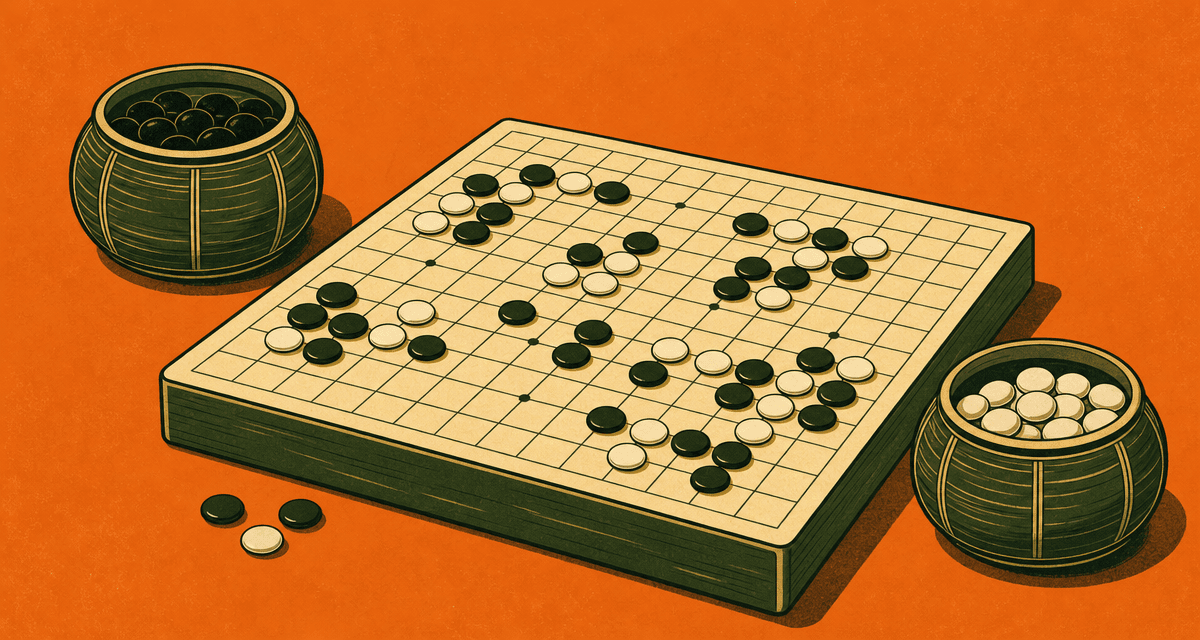
Counting territory is the heart of Go scoring. Each empty intersection completely surrounded by your living stones is one point for you.
After counting, enter your numbers on the Go score calculator along with prisoners or living stones, depending on your scoring system.
Step 1: Confirm the game is over
Both players should pass and agree no worthwhile moves remain. See How to End a Go Game.
Step 2: Remove or mark dead stones
Groups that cannot make two eyes are dead. Remove them (or agree they will be removed) before counting territory.
If you are unsure, read Dead Stones Explained.
Step 3: Count empty points inside your walls
For each region of empty points fully enclosed by your living stones:
- Count one point per empty intersection
- Do not count points inside opponent territory
- Stones on the line between territories are shared boundaries — count carefully
Example: A rectangular pocket of 6 empty points surrounded entirely by your stones = 6 territory.
Step 4: Handle seki (mutual life)
In seki, two groups share liberties and neither can capture the other. Neither side receives territory for the shared empty points.
Seki points are neutral — skip them when counting territory.
Step 5: Ignore dame (neutral points)
Dame are empty points not inside either player’s territory — often on the border between moyo or after the last competitive move. They belong to neither side in territory scoring.
Under AGA rules, players often fill dame before final counting; under Japanese rules dame may stay empty. Either way, they are not territory for either color until filled inside your walls.
Step 6: Add prisoners (Japanese / AGA)
If you use Japanese or AGA scoring, add one point per stone you captured during the game.
In Chinese scoring, skip this — count living stones instead.
Step 7: Add komi for White
White receives komi (commonly 6.5 or 7.5). See What is Komi?.
Quick checklist
- Dead stones removed or agreed
- Only your enclosed empty points counted
- Seki and dame excluded
- Prisoners added (if Japanese/AGA)
- Komi added for White
- Totals entered on the calculator
Common beginner errors
- Counting opponent territory as yours
- Forgetting prisoners in the prisoner bowl
- Treating seki interiors as territory
- Counting before agreeing which groups are dead
Related guides
Track your Go (Baduk) Score Calculator scores online
Use our free digital scorecard to add players, calculate totals automatically, and share results from any device.
Shop Go products

Affiliate links • As an Amazon Associate we earn from qualifying purchases.